Thesis
I have been doing the same thing for twenty years. I just didn't know what to call it.
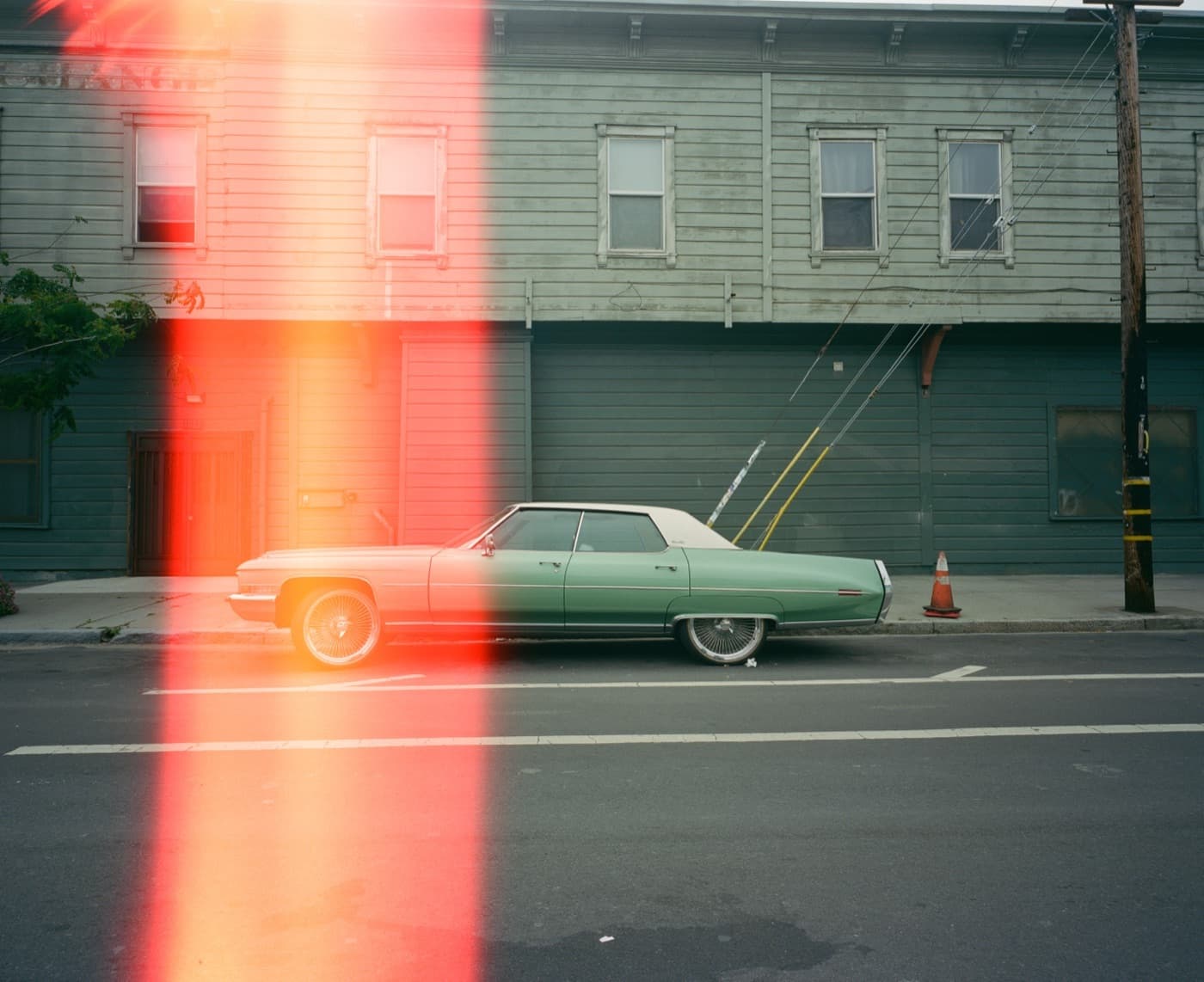
It started with photography. The technical act of capturing light, yes, but more than that, the discipline of attention. Saul Leiter, Henri Cartier-Bresson, Richard Avedon, Man Ray. These were my heroes. I attuned my eye to see the way they saw. To know what to look at when everything is visible. To know what to leave out. A photograph is not a record of what was there. It is a record of what mattered.
Then I moved into design systems. The work changed surfaces, from prints to screens to platforms, but the underlying act did not. I was still deciding what mattered. Now instead of composing a frame, I was encoding decisions into structures that other people would build on. Typography, layout, hierarchy, rhythm. The same attention, made systematic.
Then technology. I started building the things I used to hand off. Code, infrastructure, automation. And here the pattern completed itself. I was not becoming three different practitioners. I was becoming one practitioner who could see, encode, and scale. Each discipline compounded the others. Photography taught me restraint. Design taught me structure. Technology taught me leverage. Together they formed something I had never seen articulated clearly.
Three qualities kept surviving every shift.
The ability to see what others miss. Not intelligence in the academic sense. Pattern recognition applied to real problems. The client says they need a better website. The real problem is that their intake process loses half their leads before anyone responds. Seeing the actual problem is the first act.
The discipline to act on what you see. Not every pattern should be acted on. Not every automation should be built. Not every feature should ship. Judgment is the willingness to say no when the data says yes, because something in your accumulated experience tells you the data is incomplete. Antonio Damasio called these somatic markers: the body encoding decades of decisions into signals that arrive before conscious reasoning catches up. This is not intuition as mysticism. It is compressed experience, and no machine has it.
The care to make it matter. This is the one people struggle to name. I call it taste, but the word undersells it. Taste is not aesthetic preference. It is the capacity to select from infinite options based on a coherent internal model of what should exist. Iain McGilchrist's research on the divided brain points to something relevant here: the right hemisphere holds the whole while the left attends to the parts. Taste is that holding. It is what makes a system feel like someone gives a damn, rather than like a machine assembled it.
Intellect. Judgment. Taste.
Everything else is delivery.
In 2022, AI started generating images. Then video. Then code. I watched the capabilities accelerate and made a decision that felt counterintuitive at the time. I would dive into the very thing I was afraid would replace me.
I spent two years experimenting. Generating images by the thousands. Building with code I did not write by hand. Testing what these systems could do, where they broke, and what they consistently could not produce on their own.
What I found surprised me. The machines are extraordinary at execution. They converge on competent output with remarkable speed. But convergence is the tell. When a system has consumed millions of human decisions, it gravitates toward the probable. It produces echoes of what already exists. Competent, sometimes beautiful, but structurally predictable.
The human who understands where the machine converges knows exactly where to break the pattern. Not randomly. That is noise. But with the kind of informed departure that could only come from someone who understood the pattern well enough to know where deviation carries meaning. The machine provides the floor. The human builds upward from there, through restraint, through surprise, through the sequence of decisions that no probability model would arrive at, because they were not optimizing for likelihood. They were optimizing for meaning.
This is what AI revealed. Not that human creativity is threatened. That three specific human capacities were always the thing that mattered. The machines just made it impossible to ignore.
So I built a system around this understanding.
Not a methodology. Not a framework you can buy. A living architecture that treats process itself as a deliverable. Most practices produce work and send an invoice. The process is a black box. I wanted the opposite: a system where the sequence of decisions, the accumulation of judgment, the record of what was tried and what was kept, compounds into something as valuable as the output.
I designed recurring loops that illuminate insight and learn from the work itself. Mechanisms that carry forward what was discovered in one project and make it available to the next. Not as templates or best practices, but as living intelligence that metabolizes real friction into collective capability.
The system evolves. It examines its own rules. It updates what it evaluates itself by. This is not optimization, which converges on a fixed target. The target itself moves, because the system learned something it did not know it needed to learn.
Twenty years of training across photography, design, and technology aligned with a new generation of tools at exactly the right moment. The creative trajectory and the technological capability arrived at the same point. What emerged was not a practice. It is an operating system, an extension of my internal thought process. Resonant intelligence that compounds through recurrence, growing smarter with every strategic creative project it runs through.
This site is where the thinking lives.
The perspectives I publish here are not content marketing. They are the visible edge of an ongoing investigation into what happens when a creative practitioner builds at the intersection of human judgment and machine intelligence. Each one traces back to this thesis. Each one is written from inside the work, not from the outside looking in.
I believe we are entering an era where the smallest viable unit of a creative practice is one human, fully amplified. Where the value is not in the size of the team but in the quality of the attention. Where the people who understand what machines cannot do will build things that the people who rely entirely on machines never will.
To be fair, even this very thesis is a collection of hundreds of documents of thought, an aggregate of my own thinking spoken out loud, processed, reconstituted over and over as the thinking is refined. It is the synthesis, not a facsimile. And that is the difference.
If you see the same patterns, follow the work. The architecture is alive and the investigation is ongoing.
James Bogue
House of Bogue